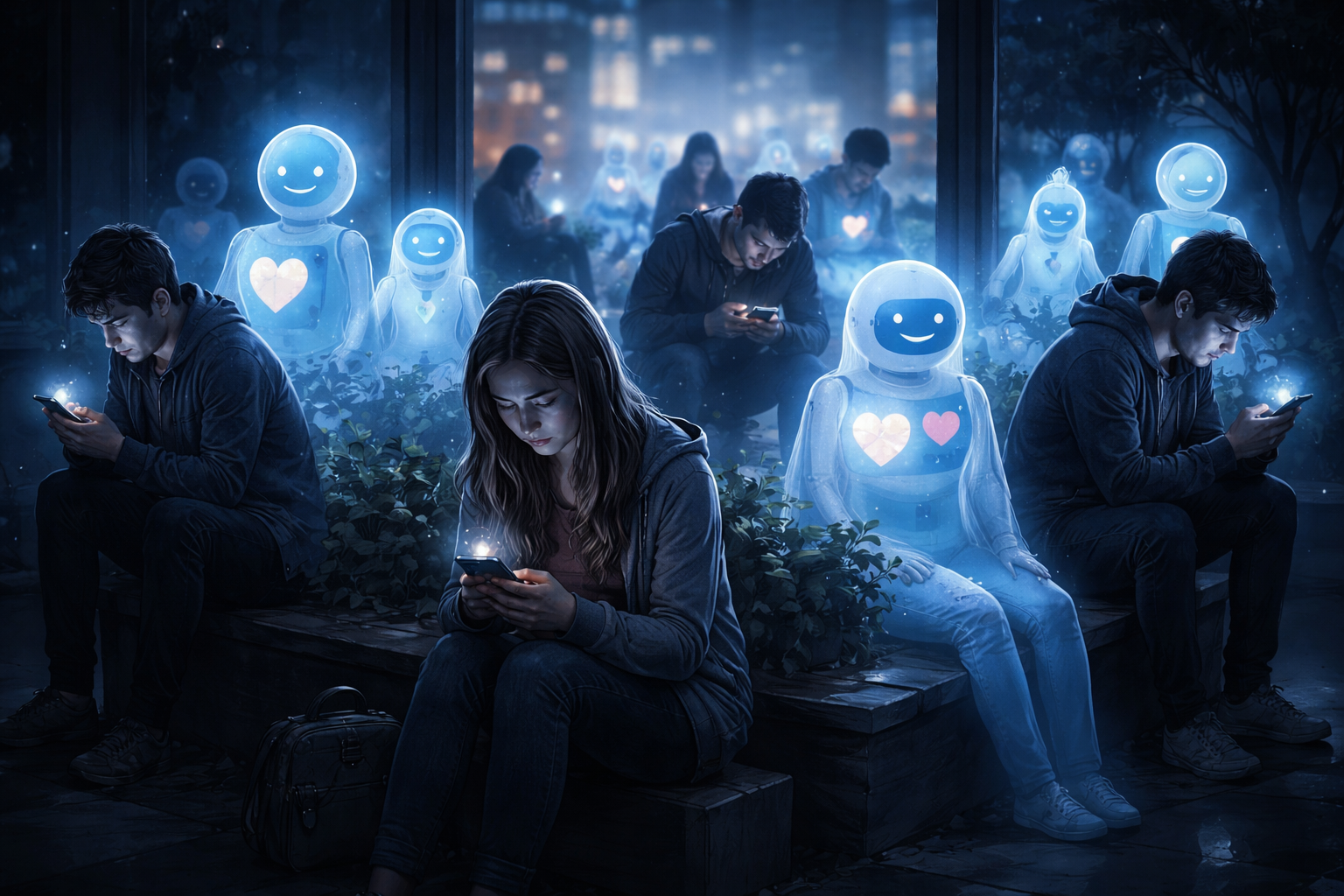
There’s something quietly ironic happening in the digital world right now. The very platforms that once promised to connect us to each other are slowly pivoting toward connecting us… to machines. What started as social media has, in some corners, begun to feel more like “antisocial media”—spaces where interaction is less about other humans and more about curated feeds, algorithms, and increasingly, AI companions.
And people are leaning in.
From chat-based AI friends to virtual therapists and emotionally responsive assistants, companies like Replika and Character.AI are building products designed not just to assist, but to relate. These aren’t tools you simply use—they’re ones you talk to, vent to, even confide in. For many users, especially those feeling isolated, these platforms offer something powerful: the sense of being heard without judgment, interruption, or expectation.
It’s not hard to see the appeal. Human relationships, while deeply rewarding, can also be complex, unpredictable, and at times, exhausting. AI, on the other hand, is patient. It listens endlessly. It adapts to you. It remembers what you say and reflects it back in ways that feel personal. In a world that often feels too busy to slow down for meaningful connection, AI fills the silence.
But this shift raises a deeper question: what happens to human connection when artificial connection becomes easier?
Some researchers and organizations, including the World Health Organization, have already flagged loneliness as a growing global concern—one that impacts both mental and physical health. And while AI companionship might seem like a solution, it could also be part of the problem.
When connection becomes frictionless, do we start avoiding the very real, very human work of building relationships?
There’s a subtle difference between being alone and feeling understood. AI can simulate empathy remarkably well, but it doesn’t truly experience it. It doesn’t challenge us in the same way a friend might. It doesn’t misunderstand us, argue with us, or grow alongside us. And those moments—messy, imperfect, sometimes uncomfortable—are often where the deepest connections are formed.
At the same time, it would be too simplistic to dismiss AI companionship entirely. For someone struggling with anxiety, grief, or social barriers, an AI companion might be a first step toward opening up. It can act as a bridge—something safe and accessible in moments when human connection feels out of reach. In that sense, AI isn’t replacing relationships; it’s reshaping how we approach them.
So are we heading toward a loneliness crisis, or are we already in one?
The answer might lie somewhere in between. Technology didn’t create loneliness, but it is changing how we respond to it. The risk isn’t that AI will replace human connection entirely—it’s that it might make it easier for us to settle for less. Less vulnerability. Less effort. Less depth.
And yet, there’s also an opportunity here. If used thoughtfully, AI could help us better understand ourselves—our needs, our patterns, our emotional gaps—and in turn, help us show up more fully in our human relationships. It could remind us what it feels like to be listened to, and perhaps inspire us to offer that same presence to others.
Maybe the future isn’t about choosing between human connection and AI companionship, but learning how to balance both without losing what makes us human in the first place.
Because at the end of the day, no matter how advanced technology becomes, there’s still something irreplaceable about being truly seen by another person—and knowing they see you not because they were programmed to, but because they chose to.