The cost of influence acts as a mirror, compelling the industry and its audience to reconsider the true price of popularity and persuasion. We wander city streets bombarded by impossibly flawless faces hawking serums and creams. Celebrities, influencers, the genetically blessed – their endorsements form a shimmering, aspirational veil draped over the beauty industry. But what lies beneath that veil? What cost does that radiant smile, that effortless recommendation, truly add to the jar sitting on your bathroom shelf?
Enter The Ordinary, a brand that has built its identity on radical transparency and disruption. In a world obsessed with gloss, they offered clinical precision. And in late 2023, they turned their unflinching gaze directly onto the often-unspoken economics of celebrity beauty deals. Their weapon? A single, branded dollar bill.
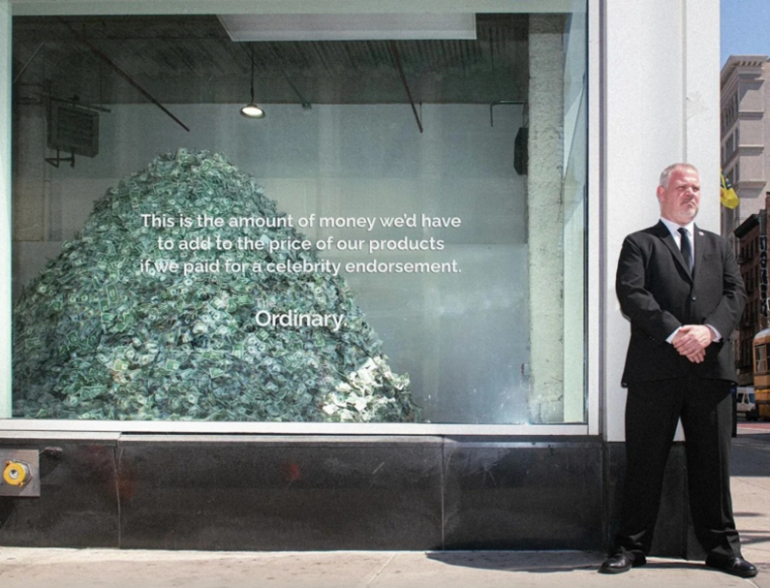
Perched in the window of their flagship store at 433 Broadway in New York City, this wasn’t just any dollar. It was a stark, visual manifesto. Printed clearly upon it: “The Ordinary. Celebrity Endorsements Would Add $20+ To This Product.” The message was jarringly simple and profoundly disruptive. It wasn’t an abstract complaint; it was a concrete, quantifiable accusation against the industry’s status quo.
The stunt, part of their “Beauty’s Secret Ingredient” pop-up with creative agency Uncommon, pulled back the curtain with surgical precision. The brand boldly stated what many consumers suspected but rarely saw quantified: paying for celebrity endorsements typically raises product prices by a staggering 30% to 100%. That $30 moisturizer? It could be $20. That $50 serum? It might cost $25. The premium wasn’t for better ingredients or revolutionary technology; it was for the face selling it.
“Celebrity endorsements are a costly ingredient that we choose not to include,” explained Prudvi Kaka, Chief Scientific Officer at DECIEM (The Ordinary’s parent company), cutting through the usual marketing spin. “We wanted to challenge the industry to rethink the value of marketing.” The dollar bill wasn’t just a critique; it was an invitation – a demand, even – for the industry and consumers to confront the hidden mark-up of fame.
This bold statement perfectly encapsulates The Ordinary’s entire marketing ethos. They are masters of subtlety and substance over spectacle. Think of their iconic billboards.
No models, no sunsets, no promises of eternal youth – just pure, unadulterated information. Their minimalist approach, focusing on ingredient efficacy and accessible pricing, is the marketing. It builds trust through radical honesty and positions the product itself, not an idealized lifestyle, as the hero.
The Broadway dollar bill was an extension of this philosophy. It wasn’t a multi-million dollar Super Bowl ad; it was a single, potent visual placed deliberately where their core audience would see it. It sparked conversation, generated organic media coverage (exactly like this article), and cemented their position as the industry’s iconoclast. They marketed by refusing to market in the traditional, costly way – and in doing so, created a far more powerful narrative.
The ripple effect of that single dollar bill continues. It forces a moment of clarity in the often-murky waters of beauty pricing. When we see a beloved star promote a luxury cream, The Ordinary asks us to pause: How much of this price tag is the formula, and how much is the face? Is the glow promised worth the invisible premium paid for the endorsement itself?
The Ordinary’s challenge stands: What if beauty marketing invested less in borrowed fame and more in the intrinsic value of the product? What if transparency, not celebrity, became the ultimate luxury? Their quiet revolution, waged with clinical serums and the occasional provocative dollar, compels us all to look beyond the gloss and question the true cost of influence reflected in every purchase. The price of persuasion, it turns out, is far higher than most of us ever realized.